Your Tax Deadlines for July 2026

- 07 July: PAYE submissions and payments
- 24 July: VAT manual submissions and payments
- 30 July: Excise duty payments
- 31 July:
-
- VAT electronic submissions and payments
- CIT Provisional Tax payments where applicable

“The bottom line is that having a purpose is good business. It is the business of the future.” (Brian Whipple, former CEO of Accenture Song)
In 2026, Gen Z and Millennials are beginning to take their place as the dominant purchasing generations. It’s a significant moment as these two generations do things differently to those that came before. Millennials established the trend, choosing to focus on values-led purchasing, driven by a preference for transparency, and a willingness to hold brands to account. Gen Z has taken it further still, treating consumption as activism.
According to McKinsey & Company, nearly 70 percent of respondents say that a brand’s social and ethical values directly influence their purchasing decisions. This deepening sense that spending choices carry moral weight, a trend known as “charitable identity”, has created a consumer bloc unlike any that has come before it. For small business owners and entrepreneurs, understanding this shift is about to become essential for future earnings.
For older generations, brand loyalty was largely built on reliability and price. For younger consumers, the framework is entirely different: brands are worn like values on a sleeve. Research from the 2024 Edelman Trust Barometer confirms that Gen Z uses brand affiliation as a form of social signalling. It’s a way of communicating who they are, and who they are not. This means that choosing to buy from a brand is less about the product and more about the statement. A clothing label with verified ethical supply chains, a bank that invests in community lending, or a coffee company that pays fair-trade premiums: these are all brands that allow the purchaser to feel that their money is doing something meaningful. In this sense, purpose-driven brands have become a form of charitable giving. The consumer simultaneously acquires a product and signals support for a cause.
Perhaps the most nuanced dimension of this trend is the ever-blurring line between consumption and philanthropy. For many younger consumers, donating to a cause and buying from a purpose-aligned brand are not distinct activities. They occupy the same emotional register: both feel like acts of conviction.
This overlap between consumption and charitable intent is transforming the way small businesses can position themselves: a clear social mission is also a business goal. If you have not made space in your annual budgets for your social mission, this must be rectified as soon as possible. You need to decide just what you stand for, and how much you can afford to invest in this aspect of your business. As your accountants, we can help you with this.
Getting involved in initiatives like Mandela Day is no longer a purely philanthropic choice. And, interestingly, small businesses have an advantage over big ones. While a large corporation can sponsor a global cause at arm’s length, a small business can muck in at a local level. From supporting the local school’s sports team, volunteering at a food bank, or committing a percentage of monthly sales to a neighbourhood cause, it’s all about making your values visible to your immediate community.
Regular and authentic charitable activity generates word-of-mouth referrals that no advertising budget can replicate. It earns coverage in local and trade media, and produces social media content that resonates precisely because it is real. It also builds internal loyalty, as employees who feel proud of where they work are more motivated and less likely to leave.
The key piece, however, is alignment. Charitable activity that feels disconnected from your business’s identity will stick out to a generation trained to detect inauthenticity at a glance. A legal firm that mentors disadvantaged youth, an accountancy practice that runs free financial literacy workshops, a café that donates unsold food to a local shelter: these are acts of giving that simultaneously tell a coherent story about who you are and what you stand for.
The practical formula is straightforward: choose causes your team genuinely cares about, build long-term partnerships rather than one-off gestures, communicate them consistently across your channels, and track the outcome not only in goodwill but in customer retention and referral rates. What you choose to do for Mandela Day is a valuable part of your brand, not just an excuse to get out of the office.

“Small is not a stepping stone. You can move. You can adjust. You can adapt. You can get it done while they’re still stuck deciding what to do.” (Jason Fried, entrepreneur and author)
When starting a small business, it’s easy to assume you don’t have all the knowledge you need to compete, and that the big, successful corporation next door holds all the keys to success. With their polished org charts, complex strategy documents, and fleets of middle managers, big corporations and their strategies can look like growth to the beginner.
This is a mistake. The truth is, big companies operate within a completely different set of constraints and economies to smaller, founder-run businesses. Understanding which big business strategies could hurt if implemented in your business, is therefore a key to survival.
Large corporations often hire ahead of demand. They build out departments, create roles to fill future needs, and staff up in anticipation of growth. They can afford to carry headcount. Smaller businesses cannot.
Many small business owners get caught up in the excitement of expansion, and start hiring to look like a bigger company, or in anticipation of future problems, rather than to solve a specific current issue. They add a layer of management before there’s anything to manage, or recruit a marketing team before they’ve validated what their customers actually want. The result is a payroll that grows faster than revenue, and a business that starts to take strain under the weight of salaries it was never ready to carry. As a new business, it is essential that each hire adds immediate value to the company and can justify their pay cheque from day one. If you are unsure what someone will do in their first 90 days, this is probably a hire you don’t need.
Big companies love processes and reporting structures. Everything from ordering printer paper to launching a new product needs multiple meetings, committee sign-offs, and documented procedures. Some of this is necessary when you’re coordinating thousands of people across continents… But for a small team, your biggest advantage is agility.
Small businesses thrive on speed and flexibility. Your ability to make a decision at 9am and implement it by lunchtime is a genuine competitive edge over a corporate rival that needs a risk assessment before it can switch toilet paper suppliers. The moment you start building bureaucracy into your own operation (think overly formal sign-off chains, or meetings about meetings) you are denting the very quality that makes you competitive.
A classic mistake many growing startups make, is one that’s also obvious to any experienced business owner the second they walk into the offices. The expensive logo on frosted glass, the branded hoodies, and the slick website are all in evidence – but the pipeline runs thin and the cash flow statement speaks of desperation.
Big companies invest heavily in brand because they have proven revenue streams and established customer relationships. Brand maintenance is a legitimate line item at that scale. For a small business still finding its feet, over-investing in brand before you have a viable business is putting the cart firmly before the horse. Customers care more about whether you solve their problem better than anyone else than they do about your brand. Earn that reputation first. The brand follows from the substance, not the other way around.
Publicly listed companies are accountable to shareholders who want to see top-line revenue growth. That pressure filters through to every level of a large organisation and shapes how it measures success. Revenue is celebrated; profit is secondary. For small and medium-sized businesses, this is a genuinely dangerous mindset to adopt.
In the early days, cash flow will be the ultimate difference between thriving and going bang. A client can owe you a large sum and your business can still fail if that money doesn’t arrive in time to cover your wages run.
But still, small business owners routinely chase headline revenue figures, winning bigger contracts, and pursuing growth at all costs without doing the hard work of understanding whether these sales are actually translating into cash flow, and whether the timing of receipts matches the reality of their outgoings. It is vital that you know the real numbers that will affect the day-to-day running of your business. And that you understand the difference between revenue and profit, and between profit and cash in the bank. As your accountants, we are here to help you see this clearly.
Enterprise businesses outsource customer service, because economies of scale demand it. For small businesses, this is a critical error, as the relationship between your business and your customers is one of the most valuable assets you possess.
When you outsource your pitches to a big agency, your customer queries to a call centre, or your social media to a junior member of staff who doesn’t really understand what you do, you lose the intimacy that made customers choose you in the first place. People buy from small businesses because they feel seen. They want the expert, not the system. Protect that connection carefully.
The bottom line is this: the best small businesses succeed by doing things that big companies structurally cannot. They move fast, know their customers personally, make smart decisions without bureaucracy, and treat every rand as precious. Lean into that while you still have it.

“All trusts established in South Africa are required to register with SARS, regardless of whether they have any transactions or income.” (SARS)
When Mr and Mrs J set up a Type-A special trust for their eldest son, who is intellectually challenged, their intention was to make certain there would always be sufficient financial resources for his best care, both during and beyond their lifetimes. A special trust was recommended by a professional advisor and with good reason: Type-A special trusts are created “solely for the benefit of a person with a mental or physical disability.”
However, as Mr and Mrs J found out, while Type-A special trusts have very compelling tax benefits, there are also substantial tax limitations. Fully understanding these within the unique personal context of the ultimate beneficiary is essential to ensuring the trust objectives are met over the long-term. And that means relying on specialist and individualised tax advice when considering a trust arrangement of any kind.
A correctly structured trust can be a powerful financial planning tool for business and property owners, wealthy individuals, or families. It can help manage succession, protect assets, provide for children or dependents, navigate estate planning issues and pass on wealth responsibly.
What is crucial is setting up the right structure for the objectives of the particular trust and understanding the consequences – and particularly the tax consequences – of the decisions made.
There are many different types of trusts in South Africa. For example, an inter vivos (living or family) trust, is created during your lifetime to hold assets such as property, business interests or investments, while a testamentary trust is created through a will (it only kicks in after your death) and is especially important where minor children are involved.
There are also vesting and discretionary trusts, and hybrid trusts that combine the two, as well as a range of specific application trusts like trading (business) trusts, charitable trusts or BEE trusts, to mention but a few.
For tax purposes, two types of special trusts are also recognised, the Type-A special trust is intended solely for a person with a mental or physical disability, as in our opening story, and the Type-B special trust created specifically for the benefit of relatives of a deceased person, provided at least one beneficiary is a minor on the last day of the trust’s year of assessment.
The trust types are not mutually exclusive. For example, a trust can technically be both a Type-A special trust and a vesting trust; or both a Type-B special trust and a discretionary trust.
However, the exact trust type really matters from a tax perspective, because Type-A and Type-B special trusts are not taxed in the same way, and both are taxed differently to normal trusts. This should be carefully considered before establishing a trust, and then disclosed when completing the mandatory annual tax returns.
In terms of what is called the “conduit principle”, trust income or capital gains may be taxed in the hands of the trust or the beneficiaries, depending on when that income or capital gain vests.
Where the trust itself is taxed, it is taxed at a flat rate of 45%. Beneficiaries are taxed at their personal tax rate on a sliding scale from 18% to 45% and also benefit from various tax rebates. SARS taxes a trust’s capital gains depending on whether the gains are retained in the trust or vested to a beneficiary in the same year of assessment. Normal trusts face an effective Capital Gains Tax (CGT) rate of 36% (calculated from an inclusion rate of 80%, which is then taxed at the flat 45% income tax).
Beneficiaries that are individual taxpayers have a maximum effective CGT rate of 18% (calculated from an inclusion rate of 40%) and also qualify for rebates such as the R50,000 annual CGT exclusion, the R3-million primary residence CGT exclusion, and disregarded CGT gains on personal-use assets or compensation for personal injury, illness or defamation.
Type-A special trusts, on the other hand, are taxed using individual income tax brackets on a progressive sliding scale from 18% to 45%.
Their capital gains inclusion rate is 40%, making their maximum effective CGT rate 18%, lower than for normal trusts and the same as for natural persons. They also qualify for CGT rebates that apply to individuals as listed above. Relief from donations tax on interest-free or low-interest loans to Type-A special trusts also applies.
However, there are some important tax limitations. Type-A special trusts do not qualify for medical tax credits, primary tax rebates, or the annual interest exemption available to natural persons. A Type-A special trust may vest income in a qualifying beneficiary so that the income is taxed in that individual’s hands, enabling the individual to use their own rebates, medical credits and interest exemption.
Bottom line: it’s complicated, so get professional tax advice based on your specific circumstances.
Whether you’re considering a special trust, an inter vivos trust, or any other structure, the differences in how income and capital gains are taxed, and what tax rebates are allowed, can have a significant impact on the real-world benefit delivered to the trust beneficiaries. The right choice depends entirely on the trust’s objectives, your unique circumstances, and a careful analysis of possible tax consequences.

“The Power of Done starts with knowing when to act.” (SARS)
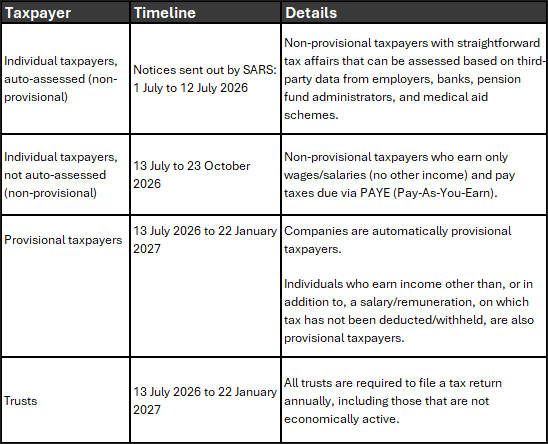
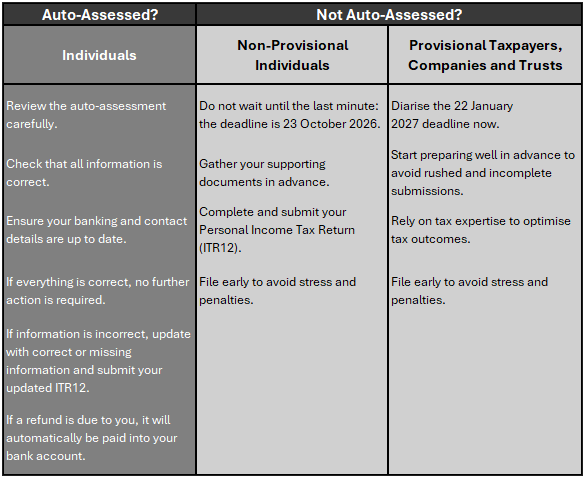
The 2026 Tax Season officially opens on 13 July 2026 for the 2025/2026 year of assessment, covering the period between 1 March 2025 and 28 February 2026.
During filing season, taxpayers must complete and submit their tax returns, declaring their income and deductions to allow SARS to determine their final tax liability for the period under assessment.
This is what we can do for you:
