Your Tax Deadlines for August 2026

ArticleImage

  • 07 August: PAYE submissions and payments
  • 25 August: VAT manual submissions and payments
  • 28 August: Excise duty payments
  • 31 August:
    • VAT electronic submissions and payments
    • PIT Provisional Tax payments (first provisional tax payment)
    • CIT Provisional Tax payments where applicable.

Everyone Makes Them: Here’s How to Recover from a Bad Business Decision

“Failure is simply the opportunity to begin again, this time more intelligently.” (Henry Ford)

Bad decisions are a near-universal leadership experience. A 2023 study of more than 14,000 employees and business leaders across 17 countries, commissioned by Oracle, found that 85 percent of business leaders have suffered from what the researchers called “decision distress” (regretting, feeling guilty about, or actively questioning a decision made) in the past year. The same study found that 72 percent of business leaders admitted they had, at some point, given up on making a decision altogether because the available data felt overwhelming. Decision-making, in other words, is hard for everyone.

What separates leaders who recover and grow from those who stall is not the absence of bad calls. It is the quality of their response.

Own it before it owns you

The most consistent thread running through research on leadership recovery is the importance of accountability. The instinct to go quiet or minimise the impact when a decision backfires is understandable, but it can also be expensive. Once an error is noticed, credibility is far harder to restore than it would have been had the leader simply spoken plainly from the outset. The fastest route to rebuilding trust is not spin, but ownership.

Diagnose the root, not just the symptom

The second step, and one that leaders under pressure are most tempted to skip, is genuinely understanding why the decision went wrong. Surface-level post-mortems, such as “we moved too fast”, or “we didn’t have enough data” only produce surface-level corrections. Durable improvement requires tracing the failure back to its actual structural cause. Was it a flawed decision-making process? Groupthink? A blind spot about the customer? Or an incentive structure that rewarded the wrong behaviour?

Denis Liam Murphy, leadership consultant and author of The Blame Game, argues that leaders need to develop what he calls “real-time hindsight”, the discipline of reflecting immediately and honestly on what a decision revealed, rather than waiting for a formal review cycle.

The Schultz playbook: Structural recovery at scale

When Schultz returned to Starbucks as CEO in January 2008, he inherited the consequences of decisions made during a period of aggressive over-expansion. The company’s stock had declined approximately 70 percent from its 2006 peak, and 600 stores were closed across 2008 and 2009. As a Harvard Business School case study on the turnaround later documented, Starbucks had drifted from the core identity that had made it successful: the experience, the craft, and the culture.

Schultz’s recovery was not built on a single dramatic gesture. It was built on a systematic return to first principles: closing 7,100 US stores for a single afternoon in February 2008 to retrain baristas, investing in the quality of the product, and making a deliberate, public commitment to slowing down in order to grow sustainably. The recovery that followed became a business school case study not because the error was unusual, but because the response to it was disciplined, transparent, and impactful in a way that resonated with the customer base.

Build the lesson into the system

The next step in the process is to build the mechanisms which help prevent mistakes from going too far into the system. This means creating what practitioners sometimes call a “failure loop”, a deliberate process for reviewing decisions, documenting what was learned, and feeding those lessons back into future decision-making frameworks.

The practical application for any business is straightforward: after a significant misstep, write down what happened and what should have been done differently. Share it with the team. Make the lesson available to the organisation, not just the person who made the call.

Resilience is not indifference

All this advice comes with a warning. Once making errors becomes consigned to a system, it opens up the possibility of leaders accepting errors as common, processing them efficiently and therefore, becoming indifferent to their impacts. On the surface this can look like emotional stoicism, but that is neither realistic nor effective. Obviously, mistakes should be avoided at all costs.

Murphy’s research points to three foundations of genuine leadership resilience: psychology, self-care, and a support network. The first is the capacity to frame struggle as information rather than verdict. The second is giving yourself the actual time and space to recover. The third is having people around you who will tell you the truth.

None of that is soft advice. The studies show that a leader who burns through a failure without adequately processing it is actually more likely to repeat it. The goal is not to feel nothing, but to feel clearly, learn quickly, and move with intention


The Subscription Trap: SMEs are Losing Thousands to “SaaS Creep”

“SaaS spend increases without founders noticing because subscriptions renew automatically, ownership is unclear, and usage is rarely reviewed as teams change.” (Michael Pantilione)

From communication channels, to shared workspaces, AI chatbots and design services, companies are aware that they are paying more for monthly subscriptions than ever before. Research, however, suggests that most firms have no idea how deep the problem goes.

The Zylo 2026 SaaS (Software as a Service) Management Index reported that the average large organisation manages 305 separate software applications. Forty-six percent of those licences sit unused at any given time, representing approximately $19.8 million in wasted annual expenditure for the average enterprise. And it’s not just a problem affecting larger businesses. According to the report, the average British SME is estimated to waste as much as R250 000 a year on software that isn’t being actively used.

These figures reflect more than careless purchasing decisions. They are a predictable consequence of how cloud software is designed to be sold, distributed, and renewed. SaaS vendors have built their distribution models around frictionless adoption and auto-renewals. For organisations that lack formal governance over their software portfolios, this dynamic produces a cost base that grows by default, irrespective of whether the tools in question are delivering measurable business value.

Why oversight fails

The central driver of SaaS creep is decentralisation. Over the past decade, purchasing authority for software has migrated steadily away from IT and finance functions and towards individual business units. The Zylo 2026 SaaS Management Index found that business units now control 81% of total SaaS spend, while IT departments directly manage just 15%. In a small business, where procurement processes are typically informal and financial controls on software purchasing are loosely enforced, this dynamic is even more pronounced.

In short, no single department maintains visibility across the full portfolio. The Marketing team acquires its own tools, Operations purchases its own platforms, and individual team members subscribe to productivity applications on corporate expense accounts. According to Productiv, approximately 48% of enterprise applications are effectively unmanaged, meaning no one in the organisation is tracking renewal dates or monitoring active usage.

Each purchasing decision is locally rational. But collectively, they produce a software stack which is almost impossible to fully understand, manage or audit.

The renewal mechanism

Automatic renewals compound the problem. SaaS vendors have no interest in identifying underutilised licences ahead of renewal as exercising the contractual right to reduce or cancel rests entirely with the buyer.

Are there solutions?

The only way of making sure you don’t become a victim of SaaS creep, is to take control of the issue and focus on visibility, ownership, and timing. Complete visibility means knowing every active subscription in the portfolio: what it costs, who authorised it, and whether it’s being used. As your accountants, we can help you conduct a full audit of subscriptions, and put together a list of just what’s being deducted and for which service. Once you know what you are subscribed to, you can decide what to keep and which to cull.

Following on from this, it’s vital to assign someone from each team to oversee subscriptions. This person needs to make the ultimate purchasing decisions, and must maintain a complete list of subscribed services. This way, subscriptions can become an element of employee onboarding and offboarding, ensuring nothing gets lost in the system and invisible renewal costs don’t pile up in the background.

The final word

SaaS creep is, at its root, an organisational design problem. It emerges predictably wherever purchases are not carefully monitored, and where auto-renewal clauses allow costs to persist beyond the point of value. For you as a business leader, the takeaway is simple: software spend requires the same disciplined oversight as any other cost.

Provisional Tax Time: First Payment for 2027 Tax Year Due 31 Aug

“Provisional tax is merely an advance payment of a taxpayer’s normal tax liability.” (SARS)

For many taxpayers, it feels as if you’re making income tax payments all the time.

It’s not far from the truth because, in South Africa, provisional taxpayers make two compulsory payments (and possibly a third voluntary payment) each year. And that’s even before the annual income tax deadline in January of the following year, when any further tax liability will become due.

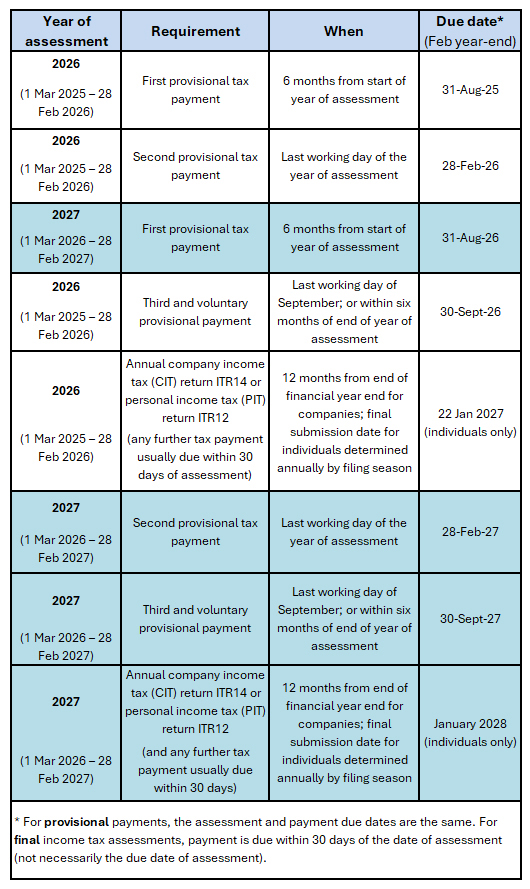
As a result, there are numerous deadlines that overlap across tax years. Yes: it is confusing, as the table below illustrates. But there’s no point throwing your arms up in the air: provisional tax non-compliance is met with some of the harshest penalties imposed by SARS.

Provisional and income tax timelines

Who are ‘provisional taxpayers’?

  • All companies except those specifically excluded
  • Any person who earns income which is not remuneration, an allowance or advance or who earns remuneration from an employer not registered for employees’ tax except those specifically excluded
  • A labour broker with an exemption certificate
  • Any person notified by the Commissioner of SARS

Why must provisional tax be paid?

Provisional tax payments are like instalments on taxpayers’ annual income tax, paid in advance and spread over two or three payments during the year. These payments are deducted against any tax owing after the year’s final income tax return is filed – at which point any further tax liability will then become due.

The objective is to prevent taxpayers from facing large income tax liabilities that are only revealed at the end of the year of assessment.

How is provisional tax declared and paid?

  • Provisional tax payments are calculated on estimated taxable income, including current taxable capital gains, for that particular year of assessment.
  • The estimates, says SARS, must be determined sensibly and by careful reasoning and judgment, in a mathematical manner, and using experience, common sense and all available information.
  • The first period estimate is forward-looking, requiring companies to estimate their taxable income for the year ahead and then to pay tax on this estimate in advance.
  • In contrast, the second period provisional return is retrospective, since by the year-end there is more certainty regarding the income for the year, and the tax due thereon.
  • These estimates of taxable income are submitted to SARS on an IRP6 return, which must be submitted by all provisional taxpayers for the first and second periods.
  • Even if you or your company owes no tax, a ‘nil’ return showing taxable income is equal to zero must still be filed on time.
  • If an IRP6 is filed more than four months after the deadline, SARS considers a ‘nil’ return to have been submitted, and unless the actual taxable income is really zero, this will result in penalties.
  • Accurate records of all the calculations and source documents used must be kept as SARS can ask for the estimate to be justified and, if dissatisfied with the amount, increase the estimate.

Your Tax Deadlines for July 2026

ArticleImage

  • 07 July: PAYE submissions and payments
  • 24 July: VAT manual submissions and payments
  • 30 July: Excise duty payments
  • 31 July:
    • VAT electronic submissions and payments
    • CIT Provisional Tax payments where applicable

Mandela Day: Why Younger Consumers Support Purpose-Driven Businesses

“The bottom line is that having a purpose is good business. It is the business of the future.” (Brian Whipple, former CEO of Accenture Song)

In 2026, Gen Z and Millennials are beginning to take their place as the dominant purchasing generations. It’s a significant moment as these two generations do things differently to those that came before. Millennials established the trend, choosing to focus on values-led purchasing, driven by a preference for transparency, and a willingness to hold brands to account. Gen Z has taken it further still, treating consumption as activism.

According to McKinsey & Company, nearly 70 percent of respondents say that a brand’s social and ethical values directly influence their purchasing decisions. This deepening sense that spending choices carry moral weight, a trend known as “charitable identity”, has created a consumer bloc unlike any that has come before it. For small business owners and entrepreneurs, understanding this shift is about to become essential for future earnings.

Identity is the new loyalty

For older generations, brand loyalty was largely built on reliability and price. For younger consumers, the framework is entirely different: brands are worn like values on a sleeve. Research from the 2024 Edelman Trust Barometer confirms that Gen Z uses brand affiliation as a form of social signalling. It’s a way of communicating who they are, and who they are not. This means that choosing to buy from a brand is less about the product and more about the statement. A clothing label with verified ethical supply chains, a bank that invests in community lending, or a coffee company that pays fair-trade premiums: these are all brands that allow the purchaser to feel that their money is doing something meaningful. In this sense, purpose-driven brands have become a form of charitable giving. The consumer simultaneously acquires a product and signals support for a cause.

Where ethical business meets charitable identity

Perhaps the most nuanced dimension of this trend is the ever-blurring line between consumption and philanthropy. For many younger consumers, donating to a cause and buying from a purpose-aligned brand are not distinct activities. They occupy the same emotional register: both feel like acts of conviction.

This overlap between consumption and charitable intent is transforming the way small businesses can position themselves: a clear social mission is also a business goal. If you have not made space in your annual budgets for your social mission, this must be rectified as soon as possible. You need to decide just what you stand for, and how much you can afford to invest in this aspect of your business. As your accountants, we can help you with this.

What this means for Mandela Day

Getting involved in initiatives like Mandela Day is no longer a purely philanthropic choice. And, interestingly, small businesses have an advantage over big ones. While a large corporation can sponsor a global cause at arm’s length, a small business can muck in at a local level. From supporting the local school’s sports team, volunteering at a food bank, or committing a percentage of monthly sales to a neighbourhood cause, it’s all about making your values visible to your immediate community.

Regular and authentic charitable activity generates word-of-mouth referrals that no advertising budget can replicate. It earns coverage in local and trade media, and produces social media content that resonates precisely because it is real. It also builds internal loyalty, as employees who feel proud of where they work are more motivated and less likely to leave.

The key piece, however, is alignment. Charitable activity that feels disconnected from your business’s identity will stick out to a generation trained to detect inauthenticity at a glance. A legal firm that mentors disadvantaged youth, an accountancy practice that runs free financial literacy workshops, a café that donates unsold food to a local shelter: these are acts of giving that simultaneously tell a coherent story about who you are and what you stand for.

The practical formula is straightforward: choose causes your team genuinely cares about, build long-term partnerships rather than one-off gestures, communicate them consistently across your channels, and track the outcome not only in goodwill but in customer retention and referral rates. What you choose to do for Mandela Day is a valuable part of your brand, not just an excuse to get out of the office.

5 Things Big Companies Do That Small Businesses Shouldn’t Copy

“Small is not a stepping stone. You can move. You can adjust. You can adapt. You can get it done while they’re still stuck deciding what to do.” (Jason Fried, entrepreneur and author)

When starting a small business, it’s easy to assume you don’t have all the knowledge you need to compete, and that the big, successful corporation next door holds all the keys to success. With their polished org charts, complex strategy documents, and fleets of middle managers, big corporations and their strategies can look like growth to the beginner.

This is a mistake. The truth is, big companies operate within a completely different set of constraints and economies to smaller, founder-run businesses. Understanding which big business strategies could hurt if implemented in your business, is therefore a key to survival.

Hiring for the org chart, not the work

Large corporations often hire ahead of demand. They build out departments, create roles to fill future needs, and staff up in anticipation of growth. They can afford to carry headcount. Smaller businesses cannot.

Many small business owners get caught up in the excitement of expansion, and start hiring to look like a bigger company, or in anticipation of future problems, rather than to solve a specific current issue. They add a layer of management before there’s anything to manage, or recruit a marketing team before they’ve validated what their customers actually want. The result is a payroll that grows faster than revenue, and a business that starts to take strain under the weight of salaries it was never ready to carry. As a new business, it is essential that each hire adds immediate value to the company and can justify their pay cheque from day one. If you are unsure what someone will do in their first 90 days, this is probably a hire you don’t need.

Complexity for the sake of it

Big companies love processes and reporting structures. Everything from ordering printer paper to launching a new product needs multiple meetings, committee sign-offs, and documented procedures. Some of this is necessary when you’re coordinating thousands of people across continents… But for a small team, your biggest advantage is agility.

Small businesses thrive on speed and flexibility. Your ability to make a decision at 9am and implement it by lunchtime is a genuine competitive edge over a corporate rival that needs a risk assessment before it can switch toilet paper suppliers. The moment you start building bureaucracy into your own operation (think overly formal sign-off chains, or meetings about meetings) you are denting the very quality that makes you competitive.

Spending unnecessarily on brand before earning the right

A classic mistake many growing startups make, is one that’s also obvious to any experienced business owner the second they walk into the offices. The expensive logo on frosted glass, the branded hoodies, and the slick website are all in evidence – but the pipeline runs thin and the cash flow statement speaks of desperation.

Big companies invest heavily in brand because they have proven revenue streams and established customer relationships. Brand maintenance is a legitimate line item at that scale. For a small business still finding its feet, over-investing in brand before you have a viable business is putting the cart firmly before the horse. Customers care more about whether you solve their problem better than anyone else than they do about your brand. Earn that reputation first. The brand follows from the substance, not the other way around.

Chasing revenue while ignoring cash

Publicly listed companies are accountable to shareholders who want to see top-line revenue growth. That pressure filters through to every level of a large organisation and shapes how it measures success. Revenue is celebrated; profit is secondary. For small and medium-sized businesses, this is a genuinely dangerous mindset to adopt.

In the early days, cash flow will be the ultimate difference between thriving and going bang. A client can owe you a large sum and your business can still fail if that money doesn’t arrive in time to cover your wages run.

But still, small business owners routinely chase headline revenue figures, winning bigger contracts, and pursuing growth at all costs without doing the hard work of understanding whether these sales are actually translating into cash flow, and whether the timing of receipts matches the reality of their outgoings. It is vital that you know the real numbers that will affect the day-to-day running of your business. And that you understand the difference between revenue and profit, and between profit and cash in the bank. As your accountants, we are here to help you see this clearly.

Outsourcing the customer service relationship

Enterprise businesses outsource customer service, because economies of scale demand it. For small businesses, this is a critical error, as the relationship between your business and your customers is one of the most valuable assets you possess.

When you outsource your pitches to a big agency, your customer queries to a call centre, or your social media to a junior member of staff who doesn’t really understand what you do, you lose the intimacy that made customers choose you in the first place. People buy from small businesses because they feel seen. They want the expert, not the system. Protect that connection carefully.

The bottom line is this: the best small businesses succeed by doing things that big companies structurally cannot. They move fast, know their customers personally, make smart decisions without bureaucracy, and treat every rand as precious. Lean into that while you still have it.

Which Trust is Right for Me? Ask a Professional

“All trusts established in South Africa are required to register with SARS, regardless of whether they have any transactions or income.” (SARS)

When Mr and Mrs J set up a Type-A special trust for their eldest son, who is intellectually challenged, their intention was to make certain there would always be sufficient financial resources for his best care, both during and beyond their lifetimes. A special trust was recommended by a professional advisor and with good reason: Type-A special trusts are created “solely for the benefit of a person with a mental or physical disability.”

However, as Mr and Mrs J found out, while Type-A special trusts have very compelling tax benefits, there are also substantial tax limitations. Fully understanding these within the unique personal context of the ultimate beneficiary is essential to ensuring the trust objectives are met over the long-term. And that means relying on specialist and individualised tax advice when considering a trust arrangement of any kind.

Why set up a trust?

A correctly structured trust can be a powerful financial planning tool for business and property owners, wealthy individuals, or families. It can help manage succession, protect assets, provide for children or dependents, navigate estate planning issues and pass on wealth responsibly.

What is crucial is setting up the right structure for the objectives of the particular trust and understanding the consequences – and particularly the tax consequences – of the decisions made.

Which trust is best for you?

There are many different types of trusts in South Africa. For example, an inter vivos (living or family) trust, is created during your lifetime to hold assets such as property, business interests or investments, while a testamentary trust is created through a will (it only kicks in after your death) and is especially important where minor children are involved.

There are also vesting and discretionary trusts, and hybrid trusts that combine the two, as well as a range of specific application trusts like trading (business) trusts, charitable trusts or BEE trusts, to mention but a few.

What about special trusts?

For tax purposes, two types of special trusts are also recognised, the Type-A special trust is intended solely for a person with a mental or physical disability, as in our opening story, and the Type-B special trust created specifically for the benefit of relatives of a deceased person, provided at least one beneficiary is a minor on the last day of the trust’s year of assessment.

The trust types are not mutually exclusive. For example, a trust can technically be both a Type-A special trust and a vesting trust; or both a Type-B special trust and a discretionary trust.

However, the exact trust type really matters from a tax perspective, because Type-A and Type-B special trusts are not taxed in the same way, and both are taxed differently to normal trusts. This should be carefully considered before establishing a trust, and then disclosed when completing the mandatory annual tax returns.

How is income for normal trusts taxed?

In terms of what is called the “conduit principle”, trust income or capital gains may be taxed in the hands of the trust or the beneficiaries, depending on when that income or capital gain vests.

Where the trust itself is taxed, it is taxed at a flat rate of 45%. Beneficiaries are taxed at their personal tax rate on a sliding scale from 18% to 45% and also benefit from various tax rebates. SARS taxes a trust’s capital gains depending on whether the gains are retained in the trust or vested to a beneficiary in the same year of assessment. Normal trusts face an effective Capital Gains Tax (CGT) rate of 36% (calculated from an inclusion rate of 80%, which is then taxed at the flat 45% income tax).

Beneficiaries that are individual taxpayers have a maximum effective CGT rate of 18% (calculated from an inclusion rate of 40%) and also qualify for rebates such as the R50,000 annual CGT exclusion, the R3-million primary residence CGT exclusion, and disregarded CGT gains on personal-use assets or compensation for personal injury, illness or defamation.

The special case of Type-A special trusts

Type-A special trusts, on the other hand, are taxed using individual income tax brackets on a progressive sliding scale from 18% to 45%.

Their capital gains inclusion rate is 40%, making their maximum effective CGT rate 18%, lower than for normal trusts and the same as for natural persons. They also qualify for CGT rebates that apply to individuals as listed above. Relief from donations tax on interest-free or low-interest loans to Type-A special trusts also applies.

However, there are some important tax limitations. Type-A special trusts do not qualify for medical tax credits, primary tax rebates, or the annual interest exemption available to natural persons. A Type-A special trust may vest income in a qualifying beneficiary so that the income is taxed in that individual’s hands, enabling the individual to use their own rebates, medical credits and interest exemption.

Bottom line: it’s complicated, so get professional tax advice based on your specific circumstances.

Our tax advice can make all the difference

Whether you’re considering a special trust, an inter vivos trust, or any other structure, the differences in how income and capital gains are taxed, and what tax rebates are allowed, can have a significant impact on the real-world benefit delivered to the trust beneficiaries. The right choice depends entirely on the trust’s objectives, your unique circumstances, and a careful analysis of possible tax consequences.

2026 Tax Season Opens: Experience the Power of Done

“The Power of Done starts with knowing when to act.” (SARS)

The 2026 Tax Season officially opens on 13 July 2026 for the 2025/2026 year of assessment, covering the period between 1 March 2025 and 28 February 2026.

During filing season, taxpayers must complete and submit their tax returns, declaring their income and deductions to allow SARS to determine their final tax liability for the period under assessment.

Dates to diarise

What’s new this filing season

  • “The Power of Done”: This year SARS is inviting taxpayers to experience “The Power of Done”, a campaign that centres on Auto-Assessments. SARS says that if you agree with your auto-assessment, you don’t need to manually file a return or do anything else, truly experiencing “The Power of Done”.
  • More prefilled data: More taxpayer information from third parties like employers, banks, medical schemes, insurers and retirement funds, is already pre-populated on returns, which means less time spent on capturing data and hopefully fewer mistakes.
  • Stricter verification: SARS has upgraded its data-matching algorithms. So even if auto-assessed, make sure to double-check that all your data (like deductions and donations) is accurate.
  • WhatsApp integration: Taxpayers can now receive their Notice of Assessment (ITA34) or Statement of Account (SOA), as well as securely upload supporting documents, directly via WhatsApp.

To be or not to be auto-assessed… Here’s what to do

Rely on our expertise for a hassle-free filing season

This is what we can do for you:

  • Verify all SARS communications are legitimate to protect you from scams.
  • Check that all taxpayer and banking details are correct and updated with SARS to facilitate refunds and to prevent identity theft and fraud.
  • Claim every tax rebate available to you to avoid you paying more tax than required.
  • Correctly prepare all required documentation early to avoid last-minute delays and to expedite a possible SARS verification or audit.
  • Check auto-assessments to ensure these are correct before they are accepted.
  • Ensure that your tax return submissions comply with current regulations.
  • Meet all submission deadlines on your behalf to avoid penalties.


Your Tax Deadlines for June 2026

  • 05 June: PAYE submissions and payments
  • 25 June: VAT manual submissions and payments
  • 29 June: Excise duty payments
  • 30 June:
  • VAT electronic submissions and payments
  • CIT Provisional Tax payments where applicable
  • End of the 2nd fiscal quarter.