Which Trust is Right for Me? Ask a Professional

“All trusts established in South Africa are required to register with SARS, regardless of whether they have any transactions or income.” (SARS)
When Mr and Mrs J set up a Type-A special trust for their eldest son, who is intellectually challenged, their intention was to make certain there would always be sufficient financial resources for his best care, both during and beyond their lifetimes. A special trust was recommended by a professional advisor and with good reason: Type-A special trusts are created “solely for the benefit of a person with a mental or physical disability.”
However, as Mr and Mrs J found out, while Type-A special trusts have very compelling tax benefits, there are also substantial tax limitations. Fully understanding these within the unique personal context of the ultimate beneficiary is essential to ensuring the trust objectives are met over the long-term. And that means relying on specialist and individualised tax advice when considering a trust arrangement of any kind.
Why set up a trust?
A correctly structured trust can be a powerful financial planning tool for business and property owners, wealthy individuals, or families. It can help manage succession, protect assets, provide for children or dependents, navigate estate planning issues and pass on wealth responsibly.
What is crucial is setting up the right structure for the objectives of the particular trust and understanding the consequences – and particularly the tax consequences – of the decisions made.
Which trust is best for you?
There are many different types of trusts in South Africa. For example, an inter vivos (living or family) trust, is created during your lifetime to hold assets such as property, business interests or investments, while a testamentary trust is created through a will (it only kicks in after your death) and is especially important where minor children are involved.
There are also vesting and discretionary trusts, and hybrid trusts that combine the two, as well as a range of specific application trusts like trading (business) trusts, charitable trusts or BEE trusts, to mention but a few.
What about special trusts?
For tax purposes, two types of special trusts are also recognised, the Type-A special trust is intended solely for a person with a mental or physical disability, as in our opening story, and the Type-B special trust created specifically for the benefit of relatives of a deceased person, provided at least one beneficiary is a minor on the last day of the trust’s year of assessment.
The trust types are not mutually exclusive. For example, a trust can technically be both a Type-A special trust and a vesting trust; or both a Type-B special trust and a discretionary trust.
However, the exact trust type really matters from a tax perspective, because Type-A and Type-B special trusts are not taxed in the same way, and both are taxed differently to normal trusts. This should be carefully considered before establishing a trust, and then disclosed when completing the mandatory annual tax returns.
How is income for normal trusts taxed?
In terms of what is called the “conduit principle”, trust income or capital gains may be taxed in the hands of the trust or the beneficiaries, depending on when that income or capital gain vests.
Where the trust itself is taxed, it is taxed at a flat rate of 45%. Beneficiaries are taxed at their personal tax rate on a sliding scale from 18% to 45% and also benefit from various tax rebates. SARS taxes a trust’s capital gains depending on whether the gains are retained in the trust or vested to a beneficiary in the same year of assessment. Normal trusts face an effective Capital Gains Tax (CGT) rate of 36% (calculated from an inclusion rate of 80%, which is then taxed at the flat 45% income tax).
Beneficiaries that are individual taxpayers have a maximum effective CGT rate of 18% (calculated from an inclusion rate of 40%) and also qualify for rebates such as the R50,000 annual CGT exclusion, the R3-million primary residence CGT exclusion, and disregarded CGT gains on personal-use assets or compensation for personal injury, illness or defamation.
The special case of Type-A special trusts
Type-A special trusts, on the other hand, are taxed using individual income tax brackets on a progressive sliding scale from 18% to 45%.
Their capital gains inclusion rate is 40%, making their maximum effective CGT rate 18%, lower than for normal trusts and the same as for natural persons. They also qualify for CGT rebates that apply to individuals as listed above. Relief from donations tax on interest-free or low-interest loans to Type-A special trusts also applies.
However, there are some important tax limitations. Type-A special trusts do not qualify for medical tax credits, primary tax rebates, or the annual interest exemption available to natural persons. A Type-A special trust may vest income in a qualifying beneficiary so that the income is taxed in that individual’s hands, enabling the individual to use their own rebates, medical credits and interest exemption.
Bottom line: it’s complicated, so get professional tax advice based on your specific circumstances.
Our tax advice can make all the difference
Whether you’re considering a special trust, an inter vivos trust, or any other structure, the differences in how income and capital gains are taxed, and what tax rebates are allowed, can have a significant impact on the real-world benefit delivered to the trust beneficiaries. The right choice depends entirely on the trust’s objectives, your unique circumstances, and a careful analysis of possible tax consequences.
2026 Tax Season Opens: Experience the Power of Done

“The Power of Done starts with knowing when to act.” (SARS)
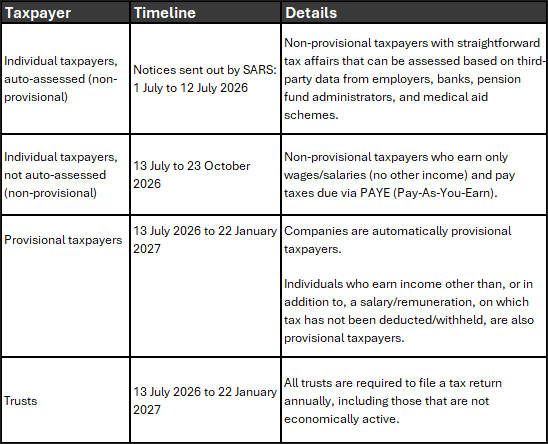
The 2026 Tax Season officially opens on 13 July 2026 for the 2025/2026 year of assessment, covering the period between 1 March 2025 and 28 February 2026.
During filing season, taxpayers must complete and submit their tax returns, declaring their income and deductions to allow SARS to determine their final tax liability for the period under assessment.
Dates to diarise
What’s new this filing season
- “The Power of Done”: This year SARS is inviting taxpayers to experience “The Power of Done”, a campaign that centres on Auto-Assessments. SARS says that if you agree with your auto-assessment, you don’t need to manually file a return or do anything else, truly experiencing “The Power of Done”.
- More prefilled data: More taxpayer information from third parties like employers, banks, medical schemes, insurers and retirement funds, is already pre-populated on returns, which means less time spent on capturing data and hopefully fewer mistakes.
- Stricter verification: SARS has upgraded its data-matching algorithms. So even if auto-assessed, make sure to double-check that all your data (like deductions and donations) is accurate.
- WhatsApp integration: Taxpayers can now receive their Notice of Assessment (ITA34) or Statement of Account (SOA), as well as securely upload supporting documents, directly via WhatsApp.
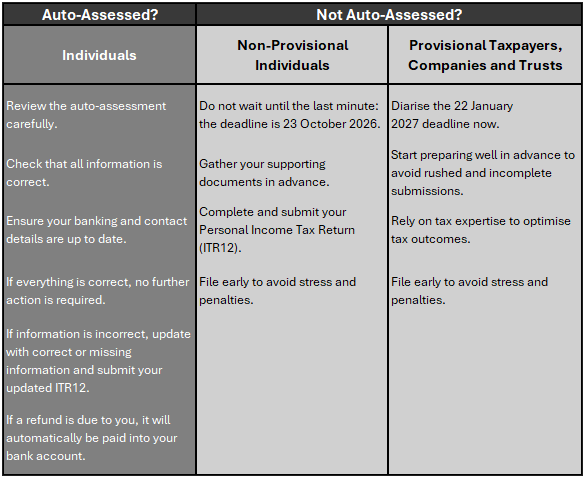
To be or not to be auto-assessed… Here’s what to do
Rely on our expertise for a hassle-free filing season
This is what we can do for you:
- Verify all SARS communications are legitimate to protect you from scams.
- Check that all taxpayer and banking details are correct and updated with SARS to facilitate refunds and to prevent identity theft and fraud.
- Claim every tax rebate available to you to avoid you paying more tax than required.
- Correctly prepare all required documentation early to avoid last-minute delays and to expedite a possible SARS verification or audit.
- Check auto-assessments to ensure these are correct before they are accepted.
- Ensure that your tax return submissions comply with current regulations.
- Meet all submission deadlines on your behalf to avoid penalties.
Your Tax Deadlines for June 2026

- 05 June: PAYE submissions and payments
- 25 June: VAT manual submissions and payments
- 29 June: Excise duty payments
- 30 June:
- VAT electronic submissions and payments
- CIT Provisional Tax payments where applicable
- End of the 2nd fiscal quarter.
