Your Tax Deadlines for April 2026

  • 01 April: Start of the 2026/27 Financial Year
  • 07 April: PAYE submissions and payments
  • 24 April: VAT manual submissions and payments
  • 29 April: Excise duty payments
  • 30 April:
    • VAT electronic submissions and payments
    • CIT Provisional Tax payments where applicable.

15% Global Minimum Tax (GMT) Goes Live at SARS

“An agreement that will really change the world.” (Olaf Scholz, former German Finance Minister)


In October 2021, a global minimum tax framework for large multinational enterprises (MNEs) was established with the introduction of the GloBE (Global Anti-Base Erosion) model rules by the OECD (Organisation for Economic Cooperation and Development).

These rules address profit shifting by multinational groups to low- or no-tax jurisdictions and ensure a minimum level of tax is paid on income in every jurisdiction in which MNEs operate.

South Africa enacted the GloBE minimum tax legislation in 2024 and 2025, enabling SARS to impose a multinational top-up tax at a rate of 15% on the excess profits of affected MNE Groups. This tax effectively brings the overall taxation of foreign profits up to a minimum agreed level of 15%, where those profits have been subject to little or no tax offshore.

As such, the GMT is expected to generate significant additional tax revenues by curbing tax avoidance, ensuring multinational corporations contribute their fair share of taxes, and extending the country’s tax base.

The GMT is expected to raise an estimated R2 billion in South African tax revenues. The broadened tax base will open opportunities to lower the personal income tax burden on individuals, or to consider more globally competitive corporate tax rates than the current 27%, which is well above the international average.

Which companies are directly affected?


The GloBE Rules apply to MNE Groups whose consolidated annual revenues equal or exceed EUR 750 million in at least two of the tax years immediately preceding the reporting fiscal year.

GMT deadlines

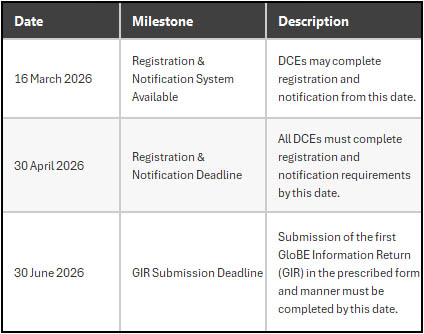
The local legislation governing GMT is deemed to have come into operation on 1 January 2024 and applies to MNEs’ subsequent “fiscal years”. Here are the deadline dates as published by SARS.

Source: SARS

How will the tax be calculated?

  • The multinational top-up tax under the GMT legislation is imposed under:
  • An Income Inclusion Rule (IIR) which taxes the domestic constituent entity (DCE) of an MNE Group on its allocable share of top-up tax arising in respect of the low-taxed income of any foreign group company in which it has a direct or indirect ownership interest.
  • A Domestic Minimum Top-Up Tax (DMTT) imposes a “joint and several” tax liability on DCEs for top-up tax arising in respect of low-taxed income, calculated on an aggregate basis but only with respect to the entities located in South Africa.

Registration and reporting obligations

  • Affected DCEs must register with SARS and file a GloBE Information Return (GIR) using the prescribed form and format by the prescribed due date.
  • SARS must be notified where a “designated local entity” is appointed by DCEs required to file a GIR.
  • DCEs must submit the notice no later than 6 months prior to the filing due date of the GIR. This due date is 15 months after the end of the reportable fiscal year for which the GIR must be filed (extended to 18 months for the 2024 fiscal year or the first fiscal year).
  • DCEs must file the first GIR no later than 18 months after the end of the first reportable fiscal year. For the 2024 reportable fiscal year the GIR must be filed before 30 June 2026 (assuming a calendar year).
  • The second and subsequent GIRs must be filed no later than 15 months after the end of the second and following reportable fiscal years.

SARS is ready: Are you?

SARS is actively preparing to administer the GloBE framework, with a dedicated project team, including IT and system engineers, and a specialised unit within its Large Business & International Unit. It aims to promote voluntary compliance and simplify adherence with the GMT legislation.

Even so, a significant compliance burden and increased reporting scrutiny awaits affected companies. They will have to comply with new and technically demanding rules, even if no global minimum tax is ultimately payable. This will likely require specialist expertise, resulting in substantial additional compliance costs.

New VAT Thresholds: Thinking of Deregistering?

“Renette Oosthuizen, small business owner from Gauteng, had this tip: ‘Minister Godongwana, please increase the VAT registration threshold for small businesses to R2 million. The R1 million threshold has not kept pace with the cost of doing business.’” (Budget Speech 2026)

Some of the best news in the 2026 Budget is the proposed increases in the compulsory VAT registration threshold from R1 million to R2.3 million and in the voluntary registration threshold from R50,000 to R120,000, with effect from 1 April 2026.

This will immediately ease the disproportionate administrative burden and compliance cost on small businesses which would have had to register soon. What’s more, VAT registered businesses may apply to deregister for VAT if they no longer exceed the increased compulsory registration threshold on 1 April 2026.

Deregistering for VAT can improve cash flow. But it’s a decision that should not be taken without consulting us, as it can trigger substantial adverse tax consequences that might well convince you not to deregister.

Reduced admin and costs

The compulsory registration threshold had not been adjusted for inflation since 2009. The new R2.3 million threshold, which slightly outstrips inflation, will ease the previously disproportionate compliance burden relative to turnover on smaller businesses. It may also spur unrestrained growth among many small businesses which felt forced to contain themselves to avoid the VAT net and its never-ending impact on admin and cashflow.

Option to deregister

Given the above, many small businesses will be keen to deregister for VAT. The good news is that it is possible for VAT registration to be cancelled – provided certain requirements are met. The first is that all outstanding liabilities and obligations in terms of the VAT Act have been resolved or settled.

The Commissioner will issue a notice of cancellation of registration which will also inform the vendor of the date on which the cancellation takes effect and the final VAT period.

SARS says output VAT on certain assets on hand at the time must also be declared together with any other output tax and input tax in the VAT return for that final tax period. In other words, you must declare the amount of output VAT on the value of the business’ assets at the date of deregistration and pay this over to SARS.

There is also a general unpaid-creditor claw-back provision that requires a vendor to reverse previously claimed input VAT by accounting for output VAT on amounts due to creditors but not paid within 12 months of the date they became payable. This rule applies throughout the VAT registration period but is also triggered immediately before a vendor ceases to be registered.

Commonly referred to as “exit VAT”, this can cause immediate and possibly substantial financial implications that could strain your cashflow.

Before deregistering

If you are interested in deregistering for VAT, we urge you to speak to us to ensure you fully understand the financial implications and can carefully plan the timing to avoid tax surprises and cash flow problems.

How to Create a Team Building Experience That Really Works

“Great things in business are never done by one person; they’re done by a team of people.” (Steve Jobs)

As a small business owner, every rand you spend needs to return value, and your team building events are no exception. When structured properly, team building days can align your staff around shared goals, strengthen communication, and clarify behavioural expectations. They will improve output, reduce internal conflict, and build a culture that supports growth. But just how do you make that happen?

Start with clear business objectives

Before choosing a venue or activity, be clear on what you want to change or improve. Are teams struggling to communicate across departments? Is accountability an issue? Are managers and staff misaligned on priorities? Defining these objectives upfront ensures the day is purposeful rather than generic.

Clear objectives also help you explain to your team why the event matters. When people understand the business reason behind the activity, engagement increases and resistance decreases.

Design activities that reflect real work challenges

The most effective team building events mirror the reality of your workplace. Activities should encourage collaboration, problem-solving, and decision-making in ways that resemble everyday business situations. When lessons feel relevant, they are much more likely to stick.

Avoid activities that are purely physical or novelty-driven if they don’t translate back to the office. Fun has value, especially when it supports insight and learning.

Include time for reflection and discussion

One of the most overlooked elements of team building is reflection. Doing the activity isn’t enough. Teams need time to discuss what happened, what worked, what didn’t, and how it relates to their daily roles. These conversations can lead to real insights. They also help teams to agree on practical changes they can make once they return to work.

It’s vital that all members of the team feel safe to speak up, ask questions and make mistakes without fear of retribution or punishment. By making sure all voices are heard on something small like losing at tug-of-war, you can reinforce that attitude in the day-to-day office space and equip your teams to perform at their best.

Reinforce leadership behaviour

Team building will only succeed if leaders model the behaviours being promoted. If collaboration, accountability, and open communication are encouraged on the day but ignored afterwards, the impact quickly fades. As a business owner or manager, you should participate fully, demonstrate vulnerability where appropriate, and reinforce lessons in the weeks that follow.

Convert insights into habits

Effective team building does not end when everyone goes home. Follow-up meetings, check-ins, and ongoing conversations are essential to embed new behaviours. Refer back to shared experiences and agreed principles when challenges arise.

Budget carefully and measure the return

As with any business initiative, cost matters. Team building exercises should be planned within a clear budget, and with a realistic view of expected outcomes. Your accountant can help you structure this spend appropriately, ensure tax considerations are handled correctly, and assess whether the investment delivers measurable returns.

Reduced absenteeism, improved productivity, and stronger retention are all indicators worth tracking. If you’re unsure how to measure impact, speak to your accountant: we can help you to access the data you need.

The bottom line

Team building that works is intentional, relevant, and accountable. It focuses on behaviour, not just morale, and it connects people more closely to the goals of your business. When done properly, it strengthens both culture and performance.

For small business owners, the key is to treat team building with the same seriousness as any other investment. Plan carefully, follow up consistently, and involve your accountant where appropriate to ensure that what you spend delivers lasting value, not just a good day out.

When Growth Is a Tax Problem

“As your profitability grows, your taxes will too. In fact, paying more taxes is an indicator that your business health is improving.” (Mike Michalowicz)

Business owners work hard to grow revenue and increase profit. What often receives less attention is how that growth alters your tax obligations. Higher turnover can trigger VAT registration. Rising profit increases provisional tax exposure. Hiring staff adds payroll compliance risk. Expansion across borders introduces new tax jurisdictions. Even improved margins can create cash flow pressure when tax payments are due before debtors settle their accounts.

Crossing the VAT threshold

In South Africa, once your taxable supplies exceed the compulsory registration threshold (recently increased from R1 million per year to R2.3 million per year), you must register for VAT. Many businesses grow quickly and miss the moment they cross it. This simple mistake can trigger penalties, interest, and backdated VAT.

Cash flow can become a second issue. You collect VAT on sales, but input VAT claims lag if suppliers don’t issue proper invoices. If you price incorrectly, you may end up funding VAT from your own margin. You might even have to pay output VAT on sales before you have received payment from your debtors.

Growth often means higher transaction volume as well. That increases the risk of errors in VAT coding, zero-rated supplies, and mixed-use expenses. It’s easy to see how a small bookkeeping mistake can easily become a material tax exposure.

Of course, there can also be benefits to registering for VAT, not least the potential right to claim input VAT on certain assets that have been purchased before you registered for VAT, and that are now used to make taxable supplies. VAT must however have been charged at the time of purchase. This can provide a nice inflow of cash, if handled correctly. Bottom line: speak to your accountant!

Provisional tax shocks

When profit rises, so does income tax. Owners often draw more cash as profits rise. They forget that tax on those profits has not yet been paid, and by the time the assessment arrives, the money is gone.

Provisional tax can be particularly problematic. Estimates based on last year’s lower profits lead to underpayment penalties when actual results are filed. Rapid growth can produce a large balancing payment in the second provisional period, or at year end.

Payroll expansion and compliance risk

Hiring staff is a sign of progress. It also triggers pay-as-you-earn (PAYE), unemployment insurance fund (UIF), and skills development levy (SDL) obligations. Errors in payroll setup multiply as your headcount increases. If payroll software isn’t configured correctly, you can under-deduct PAYE. Add penalties and interest, and growth in staff numbers can become a financial setback.

Share incentive schemes and other fringe benefits introduce potential tax complications. Without guidance, these benefits can be structured in ways that create unexpected tax costs for both employer and employee.

Operating across borders

Sometimes growth means selling beyond South Africa’s borders. Cross-border trade brings customs duties, foreign VAT, transfer pricing, and double taxation agreements into play.

A small e-commerce business that starts shipping internationally may create a permanent establishment in another jurisdiction without even realising it. That can expose them to foreign corporate tax. Currency gains and losses add volatility. If not monitored carefully, taxable income can rise even when cash flow does not.

Structural strains

The structure that worked at start-up may not suit a larger business. A sole proprietorship with modest turnover may be efficient. The same structure with higher profit can push you into a steeper marginal tax bracket.

When investors buy into new structures, share issues and valuations may raise capital gains tax and income tax questions if roll-over relief is not available. Growth may also expose structural weaknesses. Dividends tax and loans between shareholders and companies can create further tax considerations.

Capital expenditure and allowances

Expanding operations usually requires additional equipment, vehicles, or property. Tax deductions for capital assets now need to be considered. Meanwhile, disposal of older equipment may trigger recoupments or capital gains taxes. A growing business that upgrades assets frequently should definitely model the tax impact of these upgrades before committing.

Cash flow versus profit

Rapid growth often ties cash up in stock and debtors. Profit on paper doesn’t mean cash in the bank. Tax is calculated on taxable income, not on what clients have paid. What this all means is that a business can show strong profit, and owe tax on that profit, but still struggle to pay tax because of cash flow issues. Cash flow forecasting must include tax forecasting.

Audit risk

As turnover grows, so does visibility. Larger payrolls, higher VAT submissions, and bigger provisional payments attract scrutiny. Inaccurate returns that went unnoticed at a small scale can become costly when the numbers are larger.

Internal controls that were informal at start-up stage now need formal processes. Documentation matters. Contracts, invoices, and board resolutions must support your tax position. Without them, assessments become difficult to dispute.

Planning for growth, not reacting to it

Growth doesn’t create tax problems on its own. Lack of planning does.

Review your tax registrations before revenue spikes, update provisional tax estimates during the year, and align owner withdrawals with after-tax profit, not turnover. It’s also important that you reassess your entity structure as profit bands change, and model the tax impact of hiring, investing, or expanding offshore before you act.

Growth is a good problem to have. But it is still a problem if ignored. Engage your accountant early in the growth phase, not after the assessment arrives.